Guides
Do mobile notaries charge more for rush or same-day travel?
How urgency and same-day dispatch change the travel part of a mobile notary fee, plus a flat trip charge method for quoting rush, after-hours and zoned jobs.
What to take away
- A rush fee is mostly a dispatch fee, not a notarial fee. State caps apply to the act, not to the driving.
- Same-day work raises the travel component because the notary gives up scheduled stops and drives a route with no other jobs on it.
- Quote rush jobs as a flat trip charge plus the per-act fee, and put both numbers in the confirmation message.
- After-hours and weekend jobs follow the same logic, with an added premium for hours the notary would otherwise rest.
- The total matters more than the headline number. One 9 pm job still loses money if the return leg is empty.
Where the rush charge actually comes from
Travel pricing for a mobile notary has three parts: distance, time, and flexibility. Standard pricing folds the first two into a trip fee. Rush work adds the third.
When a notary takes a same-day call, that slot cannot be filled by another signing. The vehicle is committed to one address, often in traffic, often heading away from the next job.
Regulators do not set that number. New York allows a travel charge but caps the notarial act itself at $2, per the New York Department of State. California caps most acknowledgments at $15 per signature and separately allows travel, as the California Secretary of State explains.
The cap applies to the stamp. It does not apply to the drive. That split is what makes a rush quote defensible.
A defensible way to quote a rush job
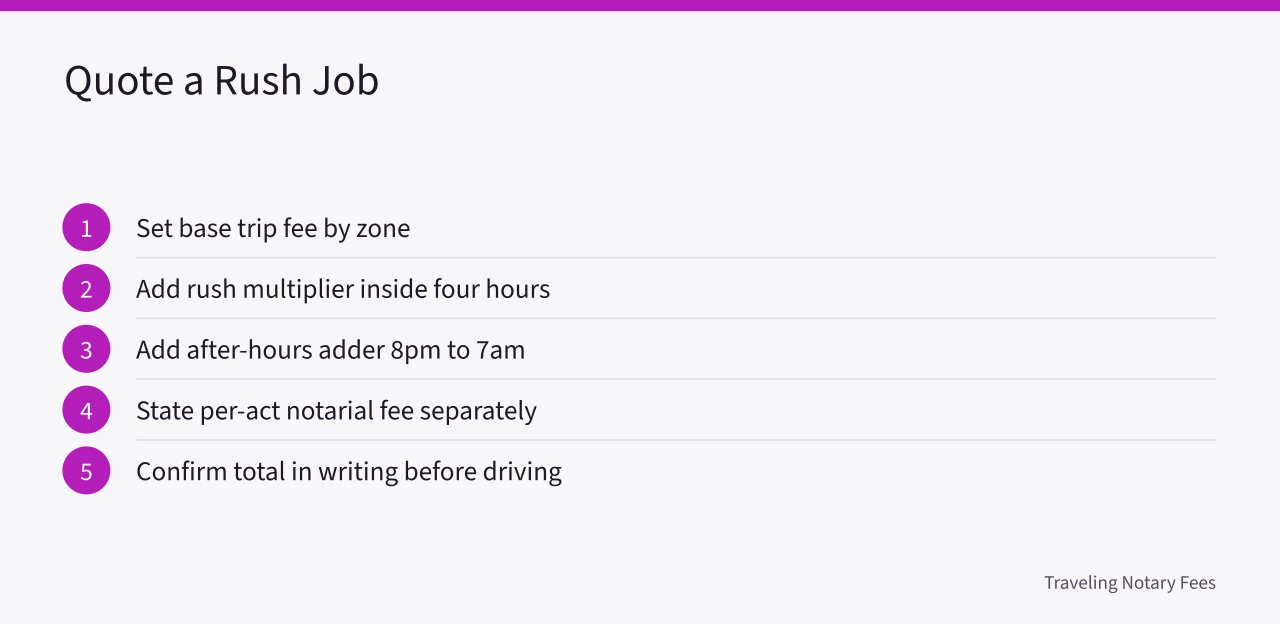
- Set a base trip fee by zone, not by mile. Three to five zones is plenty.
- Add a rush multiplier for dispatch inside four hours. A factor of 1.5 to 2 times base is common.
- Add an after-hours adder for anything booked between 8 pm and 7 am, or on a public holiday.
- State the per-act notarial fee separately, at the state maximum or below it.
- Confirm the total in writing before you start the car.
Checklist before you accept:
Before You Accept
- Address, parking, gate code confirmed
- Signer identity documents verified
- Signers and acts counted
- Cancellation window and no-show term stated
- Address, parking, and gate code confirmed
- Signer identity documents verified
- Number of signers and number of acts counted
- Cancellation window and no-show term stated
Rush, after hours, and distance compared
What changes
- Same-day dispatch
- Route cannot be batched
- After-hours timing
- Sleep and safety risk
- Distance
- Fuel and hours
- Number of acts
- Statutory cap applies
Typical treatment
- Same-day dispatch
- Rush multiplier on trip fee
- After-hours timing
- Flat adder
- Distance
- Zoned trip fee
- Number of acts
- Per signature fee
That table is a starting frame, not a rate card. Your own fuel, insurance, and time set the floor.
Example: a 9 pm same-day call
A signer calls at 6 pm for a 9 pm hospital signing, 14 miles away. The base trip fee for that zone is $45. The after-hours adder is $30, and the rush adder is $25. The act itself is one acknowledgment, billed at the state cap.
Total quoted: $100 plus the notarial fee. The trip portion has to cover fuel, wear, and roughly an hour of driving each way.
Keep mileage records for that trip. IRS Publication 463 explains how car expenses for business travel are deducted, and the standard mileage rate often beats a rough guess.
What to put in writing before you drive
A written confirmation is the cheapest protection available. It names the fee, the arrival window, and what happens if the signer is not ready.
It also sets expectations about the act itself. A notary cannot advise on the document or decide whether the signer should sign it.
Urgency does not change the notary's duties. It only changes the price of getting there.
A fee dispute can later turn into a formal complaint. The handling path depends on whether the issue is service, money, or the notarial act. This guide to complaint handling with a sceptical eye sets out the sequence.