Guides
Mobile notary travel fee: records that back up the charge
Mobile notary travel fee records: the written quote, the invoice, the mileage log and, in California, the journal entry, and what each proves in a dispute.
A travel fee is only as defensible as the records behind it. A state caps what you can charge for the notarial act and usually says nothing about the trip, so the trip charge stands or falls on what you wrote down. Four records carry the weight, and each proves something different.
What to take away
- The state caps the act, not the trip. Your proof that the trip charge was agreed lives in your own paperwork.
- A written quote shows the signer agreed. An invoice shows the split. A mileage log shows the trip happened.
- In California, every fee charged also goes into the journal, even when no fee is charged.
- A fee dispute usually starts with a verbal quote, no written disclosure, or an invoice that hides the trip charge.
What the state sets and what it leaves to your records
State fee schedules set a maximum for each notarial act. In California the maximum for an acknowledgment is $15 for each signature, and the California Notary Public Handbook adds that travel fees, if any, should be identified separately.
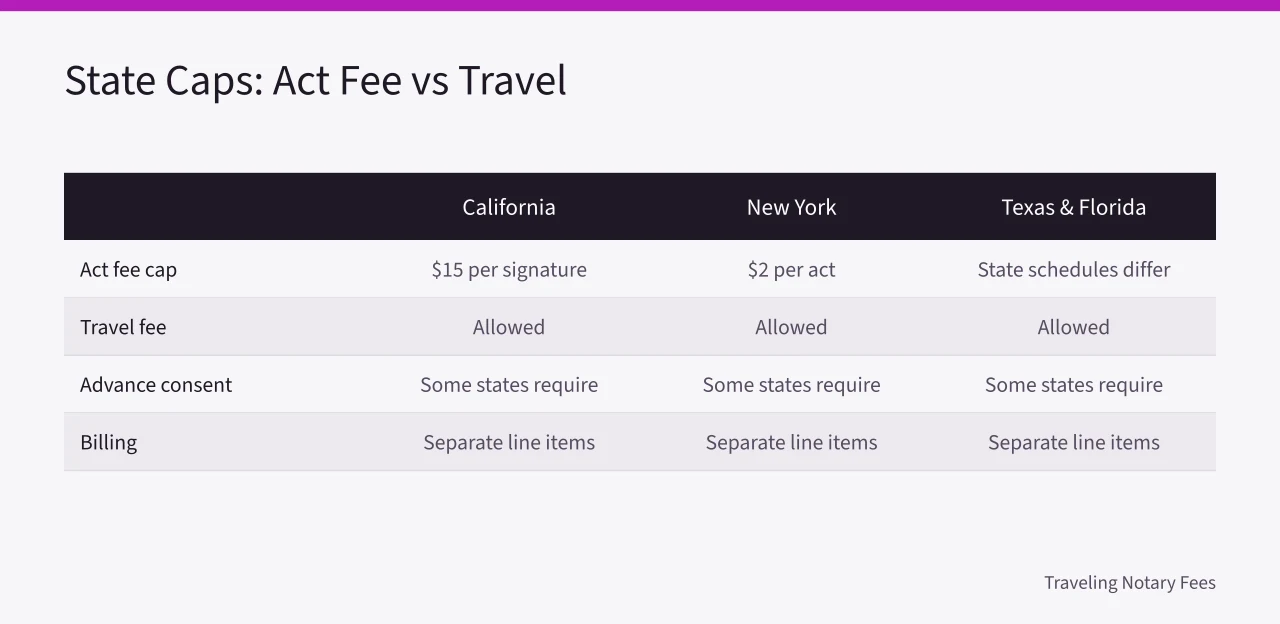
New York's fee rules sit in Executive Law section 136, published by the New York Department of State in its Notary Public License Law. The fee for an oath, an affirmation or an acknowledgment is $2. Florida Statutes section 117.05 caps the fee for any one notarial act.
The amount of the trip charge is your decision, and how the three states compare is set out in the cap comparison. What proves the charge was agreed, shown and earned is the paper you keep.
The four records and what each one proves
Each record answers a different question a signer, a client or a regulator might ask. Keep all four for every trip, because a dispute rarely turns on only one of them.
| Record | What it proves | The weak version |
|---|---|---|
| Written quote | The signer saw the trip charge as its own line before you left | A total quoted by phone |
| Invoice | The act fee and the trip charge were billed apart | One bundled number |
| Mileage log | Date, destination, purpose and miles for the trip | Memory at tax time |
| California journal | Every fee charged was entered, including a no-fee act | Entries only when money changed hands |
The quote is the record most people skip. A written fee schedule sent before the appointment, with the act fee and the travel fee as separate items, gives you a text or an email to point to later.
The invoice as evidence
An invoice that separates what you did from where you went is a record, not just a bill. It shows the signer that the travel fee is not part of the act fee, and it gives you something to produce if the charge is disputed later.
Mobile Notary Invoice Line Items
- Notarial act feesignatures at state cap
- Travel feemileage, tolls, parking
- Wait timehourly rate if signer not ready
- Additional actsextra signature, oath, acknowledgment
- Totalact fees plus trip charges
Show the act fee at or below the state cap, then the trip charge on its own line, then the total. How you arrive at the amount of that trip line is a pricing question, covered in the pricing guide.
The mileage log, appointment by appointment
Log the trip as it happens rather than reconstructing it later. The same log supports the invoice line if a signer asks about distance, and it supports the tax deduction, which is the second reason to keep it.
Documenting Mileage and Trip Charges
- Record appointment address and starting point
- Log odometer or use mileage tracking app
- Separate act fee from trip charge on invoice
- Attach toll receipts and parking stubs
- Ask signer to initial travel fee line
Documenting Mileage and Trip Charges
- Record the appointment address and your starting point before you leave.
- Log your odometer reading or use a mileage tracking app.
- Separate the notarial act fee from the trip charge on the invoice.
- Attach toll receipts and parking stubs to the same file.
- Ask the signer to initial the travel fee line before you begin.
For taxes, IRS Publication 463 says you can deduct actual expenses or the standard mileage rate, as well as business-related tolls and parking. Your log should show the date, destination, purpose and miles for each trip. The wider filing picture is in the Schedule C guide.
If you want the standard mileage rate for a car you own, you must choose it in the first year the car is available for use in your business. In a year you use it, you cannot also deduct actual car expenses.
The California journal entry
California adds a fourth record. A notary keeps one active sequential journal at a time of all official acts, under Government Code section 8206. The handbook says each fee charged must be entered in the journal, with an entry such as "no fee" or "0" when nothing was charged.
For the fee line, the handbook notes that travel fees, if any, should be identified separately. That keeps the act fee and the trip charge apart in the journal as well as on the invoice, so the two records match when someone compares them.
The journal belongs to the notary, not to an employer. When a member of the public asks in writing for a copy of a journal entry, the notary must respond within 15 business days with a copy of the line item or a statement that no such line item exists.
What the records settle in a dispute
Disputes rarely start with the amount. They start with the sequence. If you quote a total over the phone and then hand over an invoice with a separate travel fee, the signer may feel misled. If you never mention travel, the signer may refuse to pay it.
If the signer agreed by text or email and the invoice shows the split, you have a record and the argument is short. If the signer refuses anyway, you can decide whether to waive the travel fee or cancel the trip. Put the agreed terms in your written standards so every trip follows the same sequence.
Common questions
Can I charge a travel fee in California?
Yes. The California Notary Public Handbook says travel fees, if any, should be identified separately from the fee for the notarial service, which is capped at $15 per signature for an acknowledgment. Disclose the travel fee before the appointment.
Does New York allow a travel fee?
New York's fee schedule in Executive Law section 136 covers the notarial act, at $2 for an oath or an acknowledgment. Agree any trip charge with the signer in writing before you travel and bill it as a separate line.
How do I document mileage for taxes?
Keep a log with date, destination, purpose, and miles. IRS Publication 463 explains when you can use the standard mileage rate or actual expenses, and that business-related tolls and parking are deductible too.
What if the signer refuses to pay the travel fee?
If you disclosed it in writing before the trip, show the invoice and your fee schedule. If you did not disclose it, you may need to drop the charge to keep the client.